Also on the truck · Eastside
The other five
$99 to diagnose, one written figure, printed coverage — the same for every machine we take in Eastside.
Eastside kitchens hold everything from a 1950s 40-inch gas range to a coil-top electric on a 240-volt outlet installed when the house got its first dryer.
Weekdays 7:30–5:30 · Saturday 9–1 · closed Sunday · Woodland Square Loop, at the Olympia–Lacey line
$99 to diagnose, one written figure, printed coverage — the same for every machine we take in Eastside.
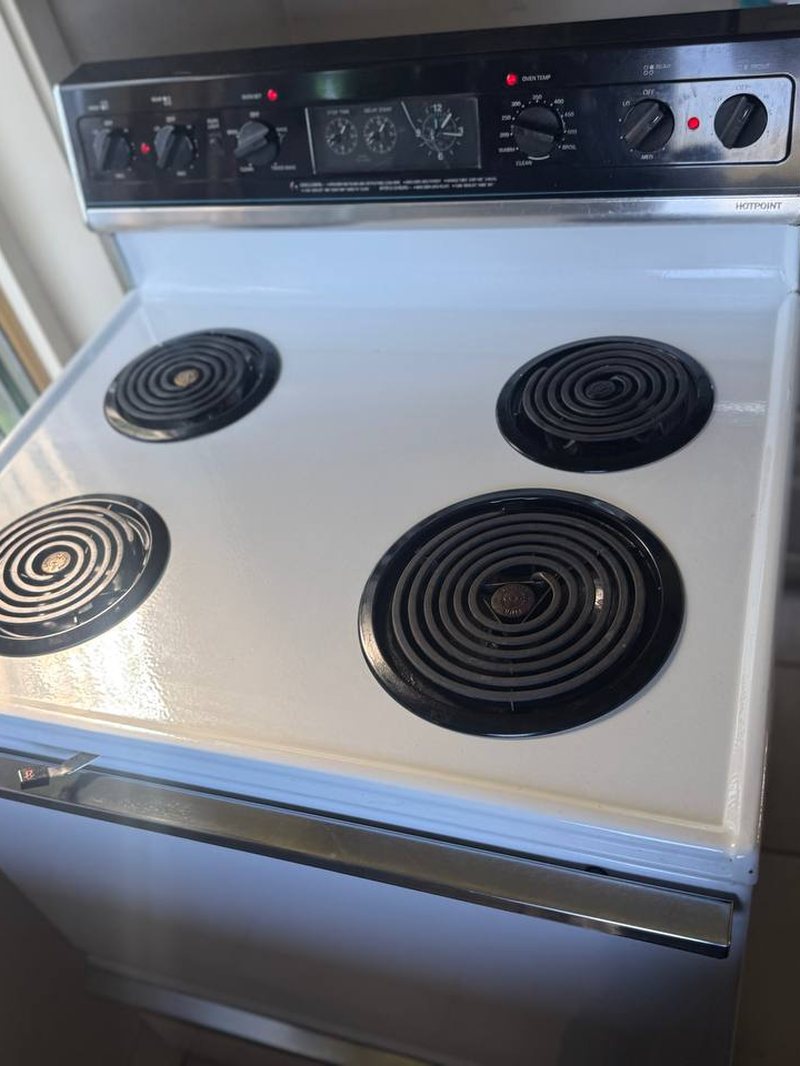
Cooking on the Eastside happens in kitchens that were laid out for a wood stove and adapted twice since. The gas line comes up through the floor from a basement that also holds the water heater. The 240-volt range outlet was added in the sixties on a three-wire circuit. The oven has been baking cakes crooked for years because the floor slopes and nobody leveled the range when it moved.
We repair ranges in these houses without judging the kitchen. The technician tests igniters and elements under load, reads gas pressure, and looks at the outlet and cord before blaming the range for something the house is doing to it.
With age a gas oven igniter loses strength; the glow is there, yet the amperage behind it no longer satisfies the safety valve. An hour of preheating gets you a lukewarm oven. We measure the igniter's current draw against spec, replace a weak one, and check the valve so the new igniter is not blamed for a valve that has also aged out.
A coil that wobbles, sparks, or heats on one side has usually cooked its receptacle, the little block it plugs into. We replace the receptacle and the element together when the pins are pitted, inspect the wiring behind for heat damage, and test the infinite switch that feeds it. Left alone, a burned receptacle eventually arcs.
Big older ovens bake unevenly when the door gasket has flattened, the bake element has a cold section, or the range sits out of level on a sloped kitchen floor. We check all three. A gasket and a level are cheap fixes; a bake element in an old oven is usually still available and worth replacing on a range this well built.
An electric range on an original three-wire outlet may show weak burners, a dead oven, or a smell of hot plastic at the wall. We test voltage at the receptacle, inspect the cord and the range's terminal block for scorching, and replace what has burned. Anything wrong inside the wall is an electrician's job and we will point you to one.
A cleaning session that shifts burner caps or bends a valve stem can leave a faint gas odor at the cooktop. We reseat the caps, check each valve stem and the flex connector with a leak detector, and confirm the flames burn blue. A strong odor means everyone out of the house and a call to the gas utility; we come afterward, once they have declared it safe.
PSE outages in ice storms end with ranges whose clock is blank and whose oven will not respond. Often a fuse on the control board has opened, a relay has stuck, or a keypad ribbon has failed under the surge. We test the incoming power, the board's fuse, and the keypad, and tell you plainly whether a board makes sense on a range this age.
You pay $99 for the diagnosis. That gets you meter readings at the range, a straight answer about the failed part, and one figure for the work. Approve it and that figure has already absorbed the $99; decline and you settle up at $99 and we part ways. Older ranges sometimes come down to parts availability, and we check that before promising a repair.
Eastside landlords and out-of-state children managing a parent's house both use us the same way: approval by text, invoice by email with the printed warranty term, and a door code kept only until the job closes. We are an independent shop with no ties to any manufacturer. A newer range that still carries the maker's coverage gets that flagged before a dollar is spent. Hours are weekday mornings through late afternoon and Saturday until 1.
Rarely. Burner valves, igniters on ranges that have them, thermostats, and door gaskets are frequently still available or adaptable. We check parts availability before the visit when you tell us the make and model. If a part cannot be had, we say so up front rather than charging you to find out.
If it is gas, probably. A weak igniter glows but cannot open the safety valve promptly, so the oven cycles slowly and never quite gets there. On an electric oven the same symptom points to a bake element or a relay. We measure rather than guess, and the fix is usually a single part.
It is a burned receptacle arcing against the element pins, and yes, it should be fixed before the range is used again. We replace the receptacle and usually the element, then check the wiring behind for heat damage. It is a common repair on Eastside coil-tops and a straightforward one.
Not necessarily for the range to work, but if the outlet or cord shows scorching, the connection is failing and the range will suffer. We test voltage and inspect the cord and terminal block. Replacing the outlet or upgrading the circuit is an electrician's work, and we will tell you if that is what we are seeing.
No. A strong gas odor means you get everyone outside and reach the gas utility before anyone else. Once they have confirmed the house is safe, call us to find and fix the range-side cause, which is often a shifted burner cap or a valve stem seal. A faint odor only when a burner is lighting is different, and we can look at that directly.
The price goes on paper before a screw comes out.
Ring or use the form; a phone photo of the display or the model sticker saves a step. We ring back with an arrival window and text again as the van pulls off Woodland Square Loop.
The technician tests the suspect part with instruments, tells you in plain words what gave out, and writes the repair down as a single price. Your $99 is already inside that number.
Fill valves, defrost heaters, igniters, drum rollers, drain pumps, relays — the things well water, salt air and PSE outages wear out on this shore of the inlet. If we have to order something, the second trip is ours to make, not yours to pay for.
You watch the machine finish a whole cycle, the kick panels and the floor go back the way they were, and the warranty term is typed onto the invoice.
Tell us over the phone. For $99 a technician tests the machine and writes the repair down as one price with that $99 folded in, and the invoice carries the warranty term in print.