In the van
LG front-loaders and top-loaders flag trouble in two letters, and the letters follow the wash cycle: filling, washing, draining, spinning, locking.
Weekdays 7:30–5:30 · Saturday 9–1 · closed Sunday · Woodland Square Loop, at the Olympia–Lacey line
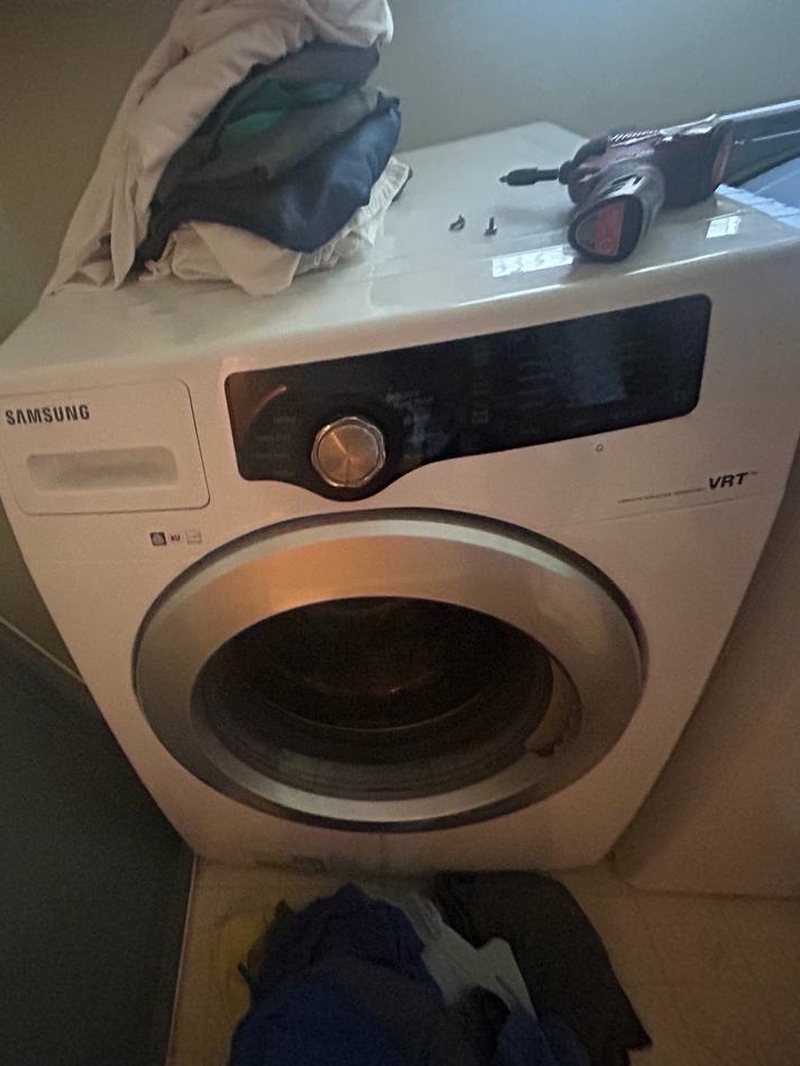
An LG washer does not sense a broken part directly. It times things. If the tub has not reached the target water level within the fill window, it shows IE. If the water is still there after the drain pump has run its allotted span, OE. If the drum cannot settle into a balanced spin after several redistribution attempts, UE. Each code marks the stage where the timer ran out, which is why one code may hide a cheap cause or a dear one.
Water and drains do the sorting for us in this corner of Washington. On private wells out toward Mud Bay, Griffin and Summit Lake, iron and scale pack the little screens where the hoses meet the valve, and IE follows. On septic, a drain hose shoved too far down a standpipe siphons and stalls, and OE follows. In the ramblers off Division Street with the washer stacked in a closet, the pedestal drawer rattles loose and UE follows. Geography is half the diagnosis.
| Code | What the display means | What is usually behind it | What we do |
|---|---|---|---|
| IE | Fill did not reach the set level in time | Usually a closed or half-open supply tap, a kinked hose or clogged inlet screens; well water with iron does the clogging quickly | Check pressure at the taps, clean or replace the screens and hoses, and test the inlet valve coils if flow is fine and the code stays |
| FE | Too much water, or the level sensor reports overfill | In most cases an inlet valve that will not shut, occasionally a pressure sensor or a blocked pressure hose reading high | Test the valve for weeping with the machine off, confirm the sensor tracks the real water level, and replace the valve or sensor at fault |
| LE | Motor locked or its rotor position sensor lost track | Often an overloaded drum or a wet-heavy load, sometimes the hall sensor on the stator, less often the motor itself | Unload and retest, test the hall sensor and the stator, and fix the sensor rather than the whole motor when that is all it is |
| tE | Water temperature sensor out of range | A thermistor reading open or shorted, or a heater that failed and took the reading with it | Compare the thermistor against a thermometer, test the heater element, and replace whichever is out of spec |
| OE | Drain did not finish in time | Lint and a sock in the pump filter, a kinked or overlong drain hose, or a standpipe that lets the hose siphon; septic setups see this most | Clear the filter and pump, correct the hose height and routing, and test the drain pump under load |
| UE | Drum could not balance for the spin | A single heavy item, a machine rocking on its feet, a loose pedestal, or tired suspension rods in a top-loader | Level the machine, check the pedestal bolts and suspension, run a balanced test load, and replace suspension parts that have gone soft |
| dE · dE1 · dE2 | Door will not lock, or the lock does not report | A door not fully latched, a strike worn by years of slamming, or a lock assembly that has failed electrically | Inspect the strike and hinge alignment, test the lock circuit, and replace the latch assembly when its switch is gone |
| PE · PF · CL · tCL | Sensor fault, power failure, child lock, tub-clean reminder | PE is a pressure sensor issue; PF simply records an outage mid-cycle; CL and tCL are settings and reminders, not faults | Clear PF and restart, show you how to release CL, and chase PE with a test of the sensor and its air hose |
Stop when the same code comes back after you have cleared the filter, fixed the hose and reset the machine, or when any code arrives with a burning smell, a puddle or a tripped breaker. Do not open the top or rear panel of a front-loader; the lock, heater and motor terminals stay live in ways that are not obvious, and the drum weights make the cabinet unforgiving. Do not run a load with LE showing to see if it clears; a stalled motor heats fast. Call the shop by the Sleater-Kinney interchange and we will bring the parts most LG codes end in.
Iron and hardness from a glacial-till well leave a rusty crust on the inlet screens, and a screen that is half blocked fills so slowly the timer expires. Cleaning helps for a season. If you have no softener or iron filter, expect it again, and ask us about a screen and hose set that is easier to service.
Then the hose is the next suspect: too long, looped above the top of the cabinet, or pushed deep into a standpipe where it siphons. On septic systems a slow-draining standpipe itself can be the cause. If the pump hums but moves no water, the impeller may be broken or jammed behind the filter, which is where we take over.
We charge $99 to come out and find the fault. You get the cause explained and the repair quoted as one written amount. Choose the repair and that amount already contains the $99, with nothing stacked on top. Decide the washer is not worth it, and $99 is all you spend on our having been there.
Not on its own. A single bath mat will throw UE on a new machine. When it shows on every load and the drum knocks the cabinet, the suspension or shock absorbers are likely tired, and we can tell you in plain terms whether repairing it is sensible given how old the washer is. The warranty term for that work is printed on your invoice.
That is common after PSE outages. The lock releases on a timer after power returns; give it a little while with the machine plugged in and the door closed. If PF or dE stays on the display and the door stays shut, the lock may need to be released by hand, and we do that without damaging the door or the glass.
What each code usually points at, what is safe to check, and where to stop.
OPEN THE CODE SHEET →E15 · E24 · E09What each code usually points at, what is safe to check, and where to stop.
OPEN THE CODE SHEET →F5E2 · F8E1 · F9E1What each code usually points at, what is safe to check, and where to stop.
OPEN THE CODE SHEET →The price goes on paper before a screw comes out.
Ring or use the form; a phone photo of the display or the model sticker saves a step. We ring back with an arrival window and text again as the van pulls off Woodland Square Loop.
The technician tests the suspect part with instruments, tells you in plain words what gave out, and writes the repair down as a single price. Your $99 is already inside that number.
Fill valves, defrost heaters, igniters, drum rollers, drain pumps, relays — the things well water, salt air and PSE outages wear out on this shore of the inlet. If we have to order something, the second trip is ours to make, not yours to pay for.
You watch the machine finish a whole cycle, the kick panels and the floor go back the way they were, and the warranty term is typed onto the invoice.
Tell us over the phone. For $99 a technician tests the machine and writes the repair down as one price with that $99 folded in, and the invoice carries the warranty term in print.