Also on the truck · Olympia
The other five
$99 to diagnose, one written figure, printed coverage — the same for every machine we take in Olympia.
An oven that will not reach temperature the week before a holiday is a call we know well.
Weekdays 7:30–5:30 · Saturday 9–1 · closed Sunday · Woodland Square Loop, at the Olympia–Lacey line
$99 to diagnose, one written figure, printed coverage — the same for every machine we take in Olympia.
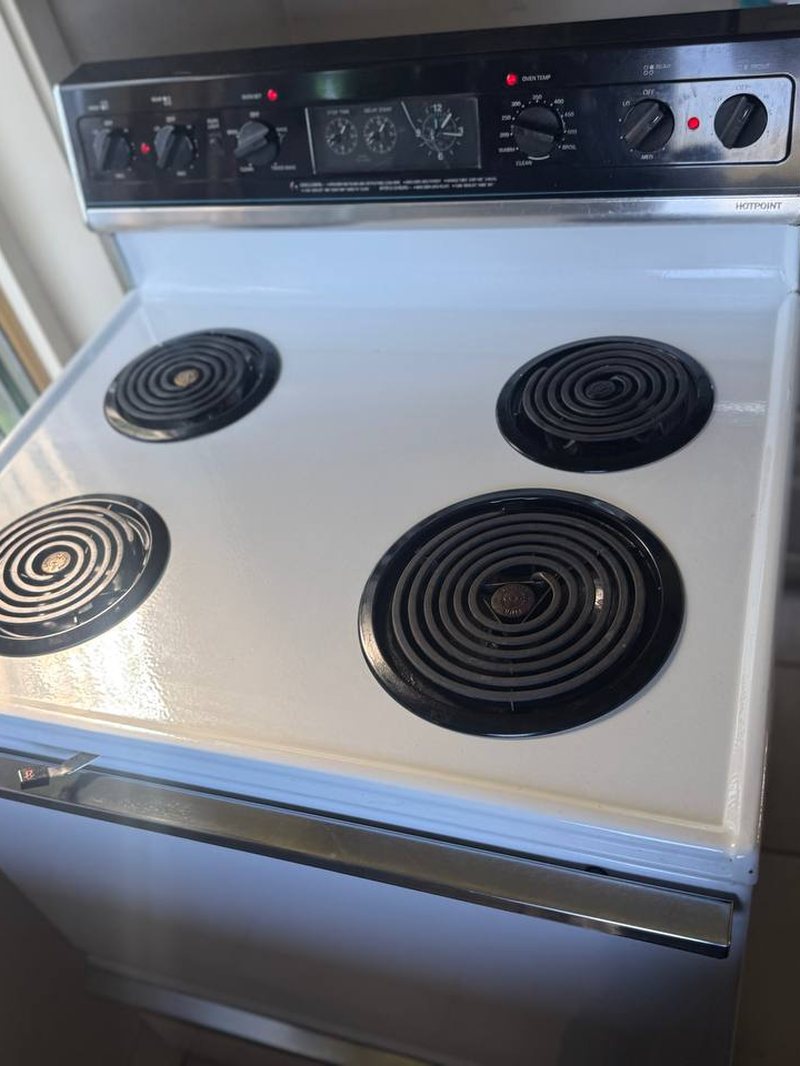
Ranges in this part of Thurston County split along the gas line. Inside Olympia, kitchens run on PSE natural gas or electric circuits, some of them in South Capitol Craftsman houses with wiring older than the appliance by half a century. Out on Steamboat Island, at Summit Lake, along Delphi Road and around much of Black Lake, propane tanks feed the range, and a unit shipped for natural gas and never properly converted burns yellow and sooty from the first meal.
We repair freestanding ranges, slide-ins, wall ovens, cooktops and the built-in Wolf, Viking, Thermador and Miele units common in Cooper Point and West Bay kitchens. Igniters, elements, sensors, spark modules and orifices for both fuels travel on the truck, so most visits end with a working oven.
The glow-bar igniter in a gas oven weakens with age until it glows orange yet pulls too little current to release the gas valve. The oven clicks, waits, and stays cold. No gas range repair comes up more often for us, from Eastside bungalows to Griffin farmhouses. We measure the igniter's amperage against the maker's specification and replace it when it falls short.
A burner that sparks continuously, or all burners sparking when one knob is turned, points to moisture in a spark switch, a cracked igniter electrode or a failing spark module. Boil-overs on a range in a wet kitchen are the usual trigger. We dry and test each switch, check the electrodes for cracks, and replace the module when it is the part misfiring.
A propane range around Summit Lake, Steamboat Island or Delphi Road that burns tall, yellow and lazy has the wrong orifices, an unset regulator or both. The result is soot on cookware, a smell in the kitchen and an oven that struggles to reach temperature. We install the correct propane orifices, set the regulator to the fuel, and adjust the air shutters until every flame is blue.
Cakes burning at the edges while raw in the middle, or roasts taking half again as long as the recipe says, mean the cavity sensor has wandered from its chart or the control's calibration is off. We hang a calibrated thermometer in the cavity, compare it to the sensor's resistance, and either recalibrate the control or replace the sensor so the dial means what it says.
One dead zone on a radiant glass cooktop is usually a burned-out element beneath the glass or a failed limiter switch; two dead zones on the same side often trace to the surface element board or a switch. In induction models, a single dead zone is more often a generator board fault. We lift the glass, meter every element and switch, and change the one that failed.
A door that stays locked long after the self-clean finished has a lock motor, a lock switch or a thermal fuse that opened during the high-heat cycle. This is common on ranges past ten years old, and a self-clean cycle is often the last straw for a tired control board too. We release the lock manually, replace the failed component, and advise on whether future self-cleans are wise.
The $99 diagnostic brings a technician to the range with meter and thermometer, and ends with the failed component identified in plain English and one repair figure written down. Approve and the $99 is treated as a payment already made against that figure. Decline, and $99 covers the visit outright, with a straight answer about whether a range this age is worth the investment.
Every invoice carries a printed warranty term for parts and labor. Anything ordered arrives on a return trip we schedule, and that trip carries no charge. If the maker still covers your range, we say so before spending anything. Landlords and second-home owners at the lakes or on the inlets text a yes, get the invoice by email, and know a gate code is held only until the job closes.
Yes, the surface burners run on a separate ignition system, so the cooktop is generally safe to use while the oven waits. The glowing igniter is drawing current but not enough to open the gas valve, which is a straightforward part replacement. If you smell gas at any point with nothing lit, shut off the supply valve and step outside before calling.
Because the orifices and regulator are still set for natural gas. Propane is delivered at higher pressure and needs smaller orifices; without the conversion the flame is oversized, yellow and sooty. We fit the correct propane orifices, set the regulator to the fuel, and adjust the air mixture until the flames burn blue.
The temperature sensor inside the oven cavity drifts with age, and the control believes a false reading. Many ranges also let the control be recalibrated a few degrees either way, which drifts over time. We compare the sensor's resistance to the maker's chart and to a real thermometer hung in the cavity, then either replace the sensor or reset the calibration.
Yes. Built-in and professional-style ranges in Cooper Point and West Bay kitchens use heavier igniters, dual-fuel controls and sealed burners with their own parts and procedures. As an independent shop we see them often, carry the tools to reach components behind the trim, and confirm whether the maker's coverage still applies before any part is ordered.
The range usually is; the wiring behind it deserves a look. Craftsman houses from the 1910s and 1920s sometimes still have an undersized or aluminum-wired range circuit, and a heating element that keeps failing can be a symptom. We test voltage at the receptacle and inspect the cord and terminal block, and we will tell you if an electrician should see the circuit.
The price goes on paper before a screw comes out.
Ring or use the form; a phone photo of the display or the model sticker saves a step. We ring back with an arrival window and text again as the van pulls off Woodland Square Loop.
The technician tests the suspect part with instruments, tells you in plain words what gave out, and writes the repair down as a single price. Your $99 is already inside that number.
Fill valves, defrost heaters, igniters, drum rollers, drain pumps, relays — the things well water, salt air and PSE outages wear out on this shore of the inlet. If we have to order something, the second trip is ours to make, not yours to pay for.
You watch the machine finish a whole cycle, the kick panels and the floor go back the way they were, and the warranty term is typed onto the invoice.
Tell us over the phone. For $99 a technician tests the machine and writes the repair down as one price with that $99 folded in, and the invoice carries the warranty term in print.