In the van
Every Bosch code we hear about describes water in the wrong place: not coming in, not going out, pooled in the base, or not hot.
Weekdays 7:30–5:30 · Saturday 9–1 · closed Sunday · Woodland Square Loop, at the Olympia–Lacey line
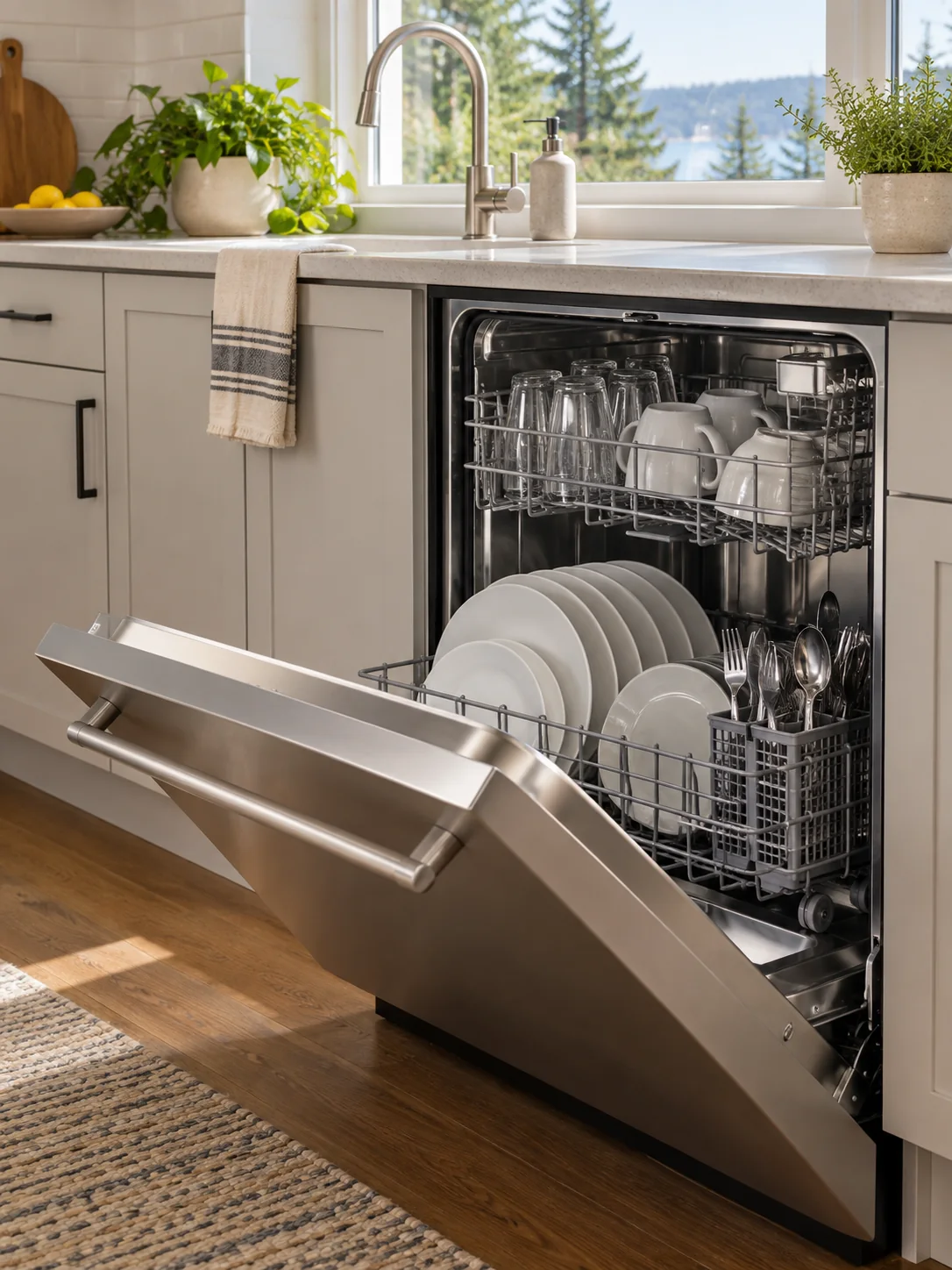
Bosch dishwashers watch three things closely: a float in the base pan, a flow meter on the inlet, and the time it takes the drain pump to empty the sump. When any of them disagrees with the program, the machine halts, sometimes begins pumping on its own, and shows an E code with a number. Newer models add a tap symbol for the same conditions. The code is a location, not a diagnosis, and E24 in a South Capitol Craftsman with a floor drain is rarely the same fault as E24 in a new Cooper Point kitchen with a garbage disposal.
Water quality sets the pattern for the heat codes. On private wells past the city line, the hardness and iron in glacial-till groundwater coat the heater in the circulation pump, and E09 and E12 arrive a year or two sooner than they would on Olympia city water. Septic systems and island sinks with air gaps shape the drain codes. Recognizing which kind of house you are standing in is most of the shortcut.
| Code | What the display means | What is usually behind it | What we do |
|---|---|---|---|
| E17 · E16 | Water is coming in when it should not, or too fast | Usually an inlet valve that leaks past its seat, sometimes very high supply pressure or a flow meter that has miscounted | Test the valve for weep with the machine off, measure supply pressure, and replace the valve or flow meter as the readings show |
| E14 · E04 | Flow meter or fill sensor did not register water arriving | Often a supply tap left barely open after a plumbing job, a kinked braided hose, or a flow meter with a stuck paddle | Confirm flow at the hose, check the meter's pulse output, and replace the meter when it is not counting |
| E24 | Drain did not complete | The classic causes: a filter matted with debris, a drain hose looped too low, a disposal installed last week with its knockout plug never punched, or an air gap packed with food | Clear the path from filter to sink, punch out the plug or clean the air gap, hang the hose in a proper high loop, and test the pump |
| E22 | Residual water left in the sump after draining | In most cases the filter is clogged or seated wrong; a pump cover popped loose or an impeller jammed by broken glass is next | Reseat and clean the filter, open the pump cover and clear the impeller, and check the check valve for debris |
| E25 | Drain pump blocked or the pump cover is off | Glass shards, a fruit pit or a label wrapped around the impeller; occasionally a failed pump motor | Clear the impeller, refit the cover, and replace the pump if the motor is seized or its winding reads open |
| E15 | The float in the base pan has lifted | Sometimes a genuine leak from a door seal, a hose or the sump gasket; often a splash or a slow drip from a supply fitting after a new faucet went in | Find the source with the panels off, dry the base pan properly, reset the float, and repair the seal or fitting that let water in |
| E09 | Heating element or its circuit failed | Usually the heater inside the circulation pump reads open, or the relay driving it on the control has quit; scale on the heater speeds this up | Meter the heater and the relay, and replace the heat pump assembly or the control as the readings dictate |
| E12 | Limescale buildup detected on the heater | Hard well water leaving mineral on the element until the machine's temperature rise falls behind schedule | Descale the machine correctly, check the heater is still sound underneath, and talk with you about softening if the house runs on a well |
Stop when E15 returns after the pan has been dried, because the water is coming from somewhere you cannot see without removing the side panels and the door, and running it further risks the floor. Stop when E09 or E12 shows, since the heater lives inside the circulation pump and testing it means a meter and a disassembly. Stop when E24 or E25 stays after the filter, hose and disposal are clear; a jammed impeller is sharp and the pump is easy to damage. We come to Olympia, Cooper Point, Mud Bay and the lakes with the Bosch parts these codes usually end in.
The float in the base needs to be fully dry and settled before the code clears, and a few tablespoons of water under the sump is enough to hold it. Tipping the machine back does not always drain the pan. If drying it thoroughly does not fix it, a slow leak from the door gasket, a hose or a sump seal is feeding it, and that needs the panels off.
It changes the questions. Septic drain fields and slow sink lines can back up into the dishwasher line, so we look at the whole path from the sump to the trap, not just the machine's pump. If the sink itself drains slowly, that is a plumbing issue we point out rather than attempt to fix.
For $99 a technician arrives with a meter and works through the dishwasher. You learn which part gave out, in everyday words, and you receive one written quotation for the fix. Say yes to that quotation and it already has the $99 built in; turn it down and the whole of what you owe for our trip is $99. There is no separate travel line anywhere inside our Olympia ring.
It shortens the road to it. Scale on the heater makes it run hotter and longer to reach temperature, which wears the element and the relay that drives it. Softened water slows the process; a periodic descaling helps too. If E12 has already shown once, plan on it again unless the water changes.
We check the serial and the terms before quoting. If the failed part is inside the maker's coverage, we tell you so and explain how to use it, since paying us for it would be a poor deal for you. If it is outside, the fix carries our own warranty term, printed on the invoice.
What each code usually points at, what is safe to check, and where to stop.
OPEN THE CODE SHEET →OE · UE · IE · LEWhat each code usually points at, what is safe to check, and where to stop.
OPEN THE CODE SHEET →F5E2 · F8E1 · F9E1What each code usually points at, what is safe to check, and where to stop.
OPEN THE CODE SHEET →The price goes on paper before a screw comes out.
Ring or use the form; a phone photo of the display or the model sticker saves a step. We ring back with an arrival window and text again as the van pulls off Woodland Square Loop.
The technician tests the suspect part with instruments, tells you in plain words what gave out, and writes the repair down as a single price. Your $99 is already inside that number.
Fill valves, defrost heaters, igniters, drum rollers, drain pumps, relays — the things well water, salt air and PSE outages wear out on this shore of the inlet. If we have to order something, the second trip is ours to make, not yours to pay for.
You watch the machine finish a whole cycle, the kick panels and the floor go back the way they were, and the warranty term is typed onto the invoice.
Tell us over the phone. For $99 a technician tests the machine and writes the repair down as one price with that $99 folded in, and the invoice carries the warranty term in print.