In the van
A Samsung refrigerator talks in letter-and-number pairs on the door display, and most of them point at a fan, a sensor or a heater rather than the compressor.
Weekdays 7:30–5:30 · Saturday 9–1 · closed Sunday · Woodland Square Loop, at the Olympia–Lacey line
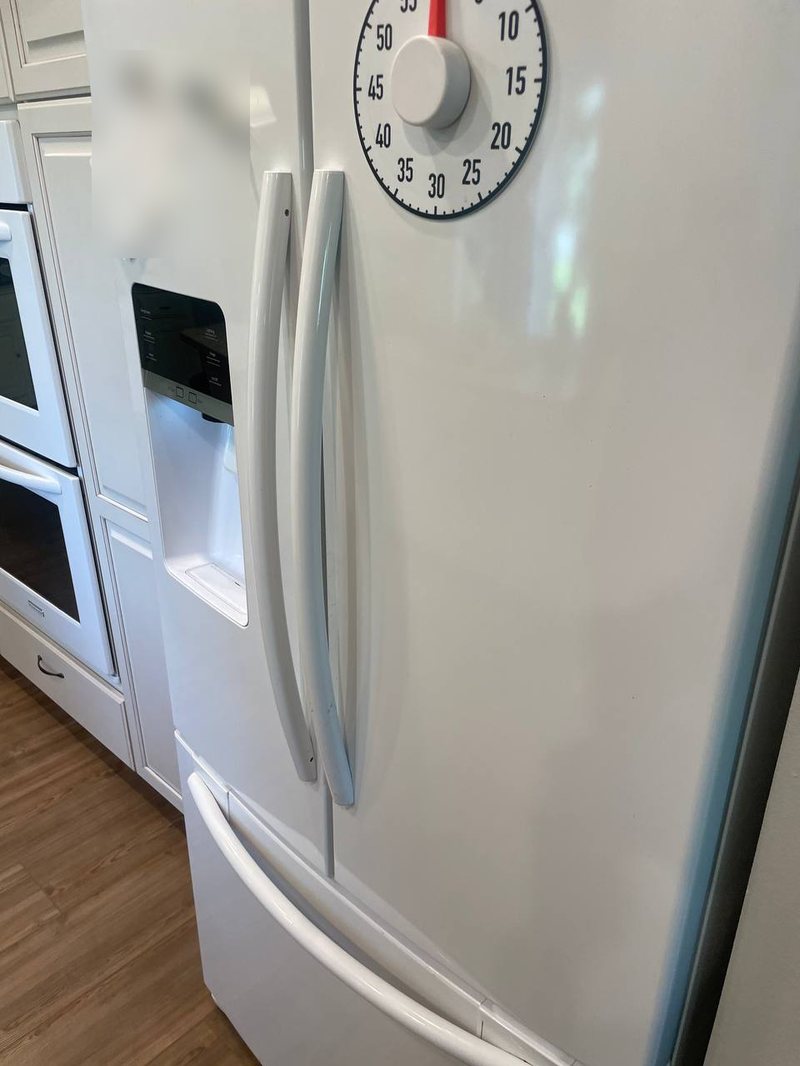
Samsung refrigerators run a self-test every time they power up and keep polling their sensors while they cool. When a reading falls outside the window the main board expects, the display swaps the temperature for a code: a number for the circuit and a letter, E or C, depending on the model year. The code does not say which component failed; it says which circuit is complaining. A 22E fan fault can be a dead motor, or it can be a fan frozen solid because a door gasket has been leaking warm air all summer.
Around Olympia the calendar matters. The morning after a PSE outage, we field a run of calls where the display is stuck on 88 88 or blinking, the compressor never restarted, or an 84C appeared as the power stuttered back on. Garage refrigerators on Cooper Point and Steamboat Island bring the second wave: damp air and pet hair on the condenser push a marginal fan over the edge, and the board notices before the family does.
| Code | What the display means | What is usually behind it | What we do |
|---|---|---|---|
| 88 88 · blinking display | Power was interrupted and the control has not finished its restart routine | In most cases nothing is broken; the board is waiting for a reset after a PSE flicker or a breaker trip | Reset the control, then confirm the compressor and both fans pick up and the cabinet pulls down to temperature |
| OF OF · O FF | Cooling Off, sometimes called demo or showroom mode, has been switched on | Usually a button combination pressed by accident while cleaning the panel, or a child at the display; the lights work but nothing cools | Take the refrigerator out of demo mode, verify cooling resumes, and show you the button sequence in case it happens again |
| 84C | The compressor tried to start and locked, or drew more current than the inverter allows | Often a start attempt against high pressure right after an outage; sometimes a weak inverter board, less often the compressor itself | Read the inverter's output and the windings of the compressor, watch the start sequence, and give you a straight answer on board versus sealed system |
| 22E · 22C | Refrigerator-side evaporator fan is not turning at the speed the board asked for | Usually ice around the fan blade from a gasket leak or a missed defrost; a failed fan motor is the second guess | Clear the ice, find out why it formed, test the fan under power, and replace the motor or fix the defrost fault behind it |
| 21E · 21C | Freezer evaporator fan fault | Same story on the freezer side: a frost-locked blade, a worn motor, or a wiring pinch near the rear panel | Pull the back panel, check the fan and harness, and correct the defrost problem if frost is the real cause |
| 5E · 5C | Refrigerator defrost sensor reading out of range | In most cases the sensor itself has drifted or opened; occasionally the defrost heater has failed and the sensor is reporting honestly | Compare the sensor's resistance to spec at a known temperature, test the heater, and replace what actually failed |
| 23E · 23C | Condenser fan fault | Down in the machine compartment: dust and hair packed into the fan, a seized bearing, or a wire nibbled by a mouse in a garage | Clean the compartment, test the motor, and check the compressor was not running hot as a result |
| 33E · 33C · 41C | Ice maker heater or ice room fault | 33E is typically the fill-tube heater; 41C on Family Hub models generally means the ice maker stalled or the ice room ran warm | Test the heater circuit, look for an ice plug in the fill tube, cycle the ice maker by hand, and check the seal on the ice room door |
Stop when a reset brings the same code back, when the freezer is above zero and climbing, or when you can hear the compressor cycling on and off in short bursts. Do not pull the rear panel to chip ice with anything metal; the evaporator tubing sits right behind it and one puncture turns a fan repair into a sealed-system loss. Do not attempt to bypass a sensor or jumper the inverter. If food is warming, move it to a cooler and call before noon; a refrigerator that has gone warm is a same-day job, and the other codes are booked within the week.
Often, yes. Many Samsung models hold a blinking display or an 88 88 pattern until they are reset, and some drop into a state where the compressor waits for a start signal that never comes. Unplugging for a short spell usually clears it. If the display resets but cooling does not return, or the code comes back the next morning, that is when to book the visit.
The visit is $99. That buys a technician standing at your refrigerator with a meter, the failed component identified in ordinary language, and a single figure in writing for the fix. Give the go-ahead and that $99 is already counted within the figure. Turn it down and your total for the visit stays at $99.
Not usually in itself. The code tells us the refrigerator-side fan is not turning, and the common reason is ice around the blade. The concern is what let the ice form: a leaking gasket, a failed defrost part or a door left ajar in a busy kitchen. We fix the cause along with the fan so you are not back at the same code in a month.
Yes, before any part is quoted. If the serial number puts your refrigerator inside the maker's term for the failed component, we say so and explain the route rather than charging you for something the manufacturer should be handling. We are an independent shop, so we can be straight with you about it.
It does. A garage refrigerator breathes damp air for most of the year, and its condenser fan clog faster with dust and hair than kitchen units do. Cold winter garages also confuse single-thermostat models. If yours is throwing 23E or drifting warm, we can say whether repairing it where it sits makes sense or whether the garage is the problem.
What each code usually points at, what is safe to check, and where to stop.
OPEN THE CODE SHEET →E15 · E24 · E09What each code usually points at, what is safe to check, and where to stop.
OPEN THE CODE SHEET →F5E2 · F8E1 · F9E1What each code usually points at, what is safe to check, and where to stop.
OPEN THE CODE SHEET →Samsung repair in Olympia → · Refrigerator & Freezer Repair →
The price goes on paper before a screw comes out.
Ring or use the form; a phone photo of the display or the model sticker saves a step. We ring back with an arrival window and text again as the van pulls off Woodland Square Loop.
The technician tests the suspect part with instruments, tells you in plain words what gave out, and writes the repair down as a single price. Your $99 is already inside that number.
Fill valves, defrost heaters, igniters, drum rollers, drain pumps, relays — the things well water, salt air and PSE outages wear out on this shore of the inlet. If we have to order something, the second trip is ours to make, not yours to pay for.
You watch the machine finish a whole cycle, the kick panels and the floor go back the way they were, and the warranty term is typed onto the invoice.
Tell us over the phone. For $99 a technician tests the machine and writes the repair down as one price with that $99 folded in, and the invoice carries the warranty term in print.