When a GE oven flashes an F-code and starts beeping at two in the morning, the code is more useful than it looks.
Weekdays 7:30–5:30 · Saturday 9–1 · closed Sunday · Woodland Square Loop, at the Olympia–Lacey line
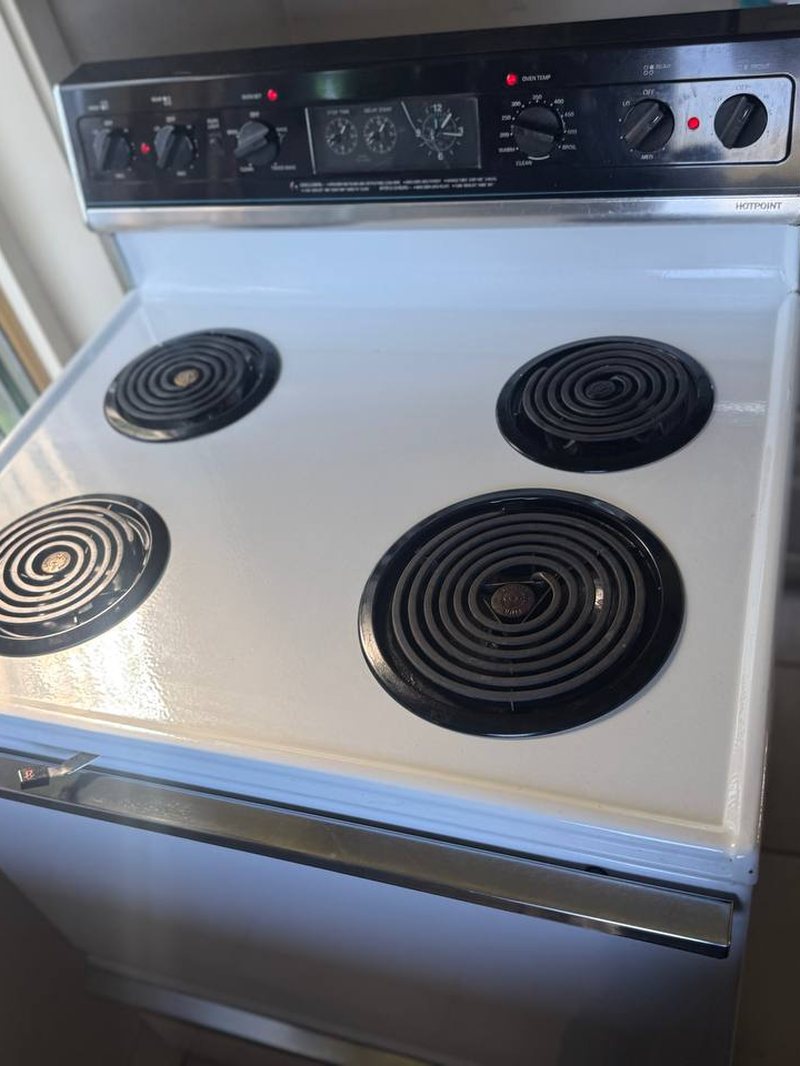
GE ranges outnumber every other brand in the 1920s houses of the Eastside and the ramblers around Capital Mall, partly because they have been the default choice at local appliance stores for fifty years. The electric ones run bake and broil elements off an electronic clock control; the gas ones use a glow-bar igniter whose current draw is what lets the oven valve open. The F-codes on the display come from that control, and they are surprisingly specific.
A GE oven that beeps F2 has overheated or thinks it has. F3 says the temperature sensor is reading open or shorted. F7 is a stuck key. F9 is the door lock. We note the code, meter what it accuses, and then ask whether the control itself is the real problem, because sometimes it is.
The oven climbs past its set point, food burns, and F2 appears with an endless beep. In most cases the sensor has drifted high, or the bake relay on the control has welded closed so the element never shuts off. We meter the sensor cold against GE's table, test the relay output, and replace whichever has failed. A relay stuck on is a safety matter.
F3 is the oven sensor reading out of range, and a sensor that has drifted low without tripping the code leaves you with a roast running an hour behind the recipe. The sensor is a probe at the back wall with a known cold resistance. We check it, inspect its connector for the corrosion damp Olympia kitchens produce, and replace probe or harness as the reading dictates.
On a GE gas oven the igniter glows orange but no flame appears for minutes, or the oven lights late and unevenly. An aging igniter pulls fewer amps, and under a threshold the safety valve stays shut. We measure amperage instead of trusting the glow, replace a weak igniter, and on propane ranges around Griffin and Delphi check orifices and flame color while the burner is exposed.
A bright spot, a pop and a smell, and the oven no longer heats on bake. The element has opened, often visibly. Replacing it is quick; what matters is checking why, because on the older Eastside houses with tired wiring a loose neutral at the range receptacle can stress elements and controls alike. We replace the element and confirm voltage at the terminal block is what the oven expects.
One radiant element on a GE smooth-top stays cold, or it heats only on high, or the hot-surface light stays on after everything is off. The radiant element, its limiter, and the infinite switch under the knob each cause one of these. We test element and limiter, replace a burned switch, and look the glass over for cracks that would let spills reach live parts.
F7 means the control believes a key is being held down, either a failed membrane keypad or a control that has lost its mind. F9 means the self-clean door lock did not reach the position the control expected. On many GE models keypad and control are one part, so we test carefully before ordering. For F9 we check the lock motor and switches and release the door.
| Code | What it usually means | What we do |
|---|---|---|
| F2 | The control detected an oven temperature above its limit, in most cases a drifted sensor or a bake relay stuck on. | Meter the sensor, test the relay output, and replace the failed part; a stuck relay gets treated as a safety issue. |
| F3 | The oven sensor is reading open or shorted, leaving the control unable to regulate heat. | Check sensor resistance and connector, then fit a new probe or mend the harness. |
| F7 | One key seems to the control to be held down continuously, usually a failed keypad or the control itself. | Isolate the keypad from the control to prove which has failed, then replace only that part. |
| F9 | The self-clean door lock did not reach the expected position, or its switches disagree with the motor. | Test the lock motor and switches, release a locked door, and replace the lock assembly when it has failed. |
For a GE range the diagnostic is $99, which puts a technician and a meter at the oven and ends with a specific answer about which part failed, plus a repair figure written on your ticket. Okay the repair and that figure already includes the $99; wave it off and $99 changes hands, nothing more. No travel charge anywhere in our ring, which spreads out from the shop by the Sleater-Kinney interchange, and if GE's own coverage still applies to your range, we mention it before you spend anything.
Ranges are booked inside the week. Common GE sensors, igniters and elements ride with us; an ordered control board comes back on a trip we schedule with nothing added. Every invoice carries the printed warranty term. Downtown rental managers can approve over text, and the invoice reaches them by email.
It can be. F2 means the control registered an oven temperature past its limit. If the bake relay on the control has failed closed, the element can stay on regardless of the setting, so shut the breaker off until it is looked at. If the sensor has simply drifted, the oven will be fine once it is replaced. We tell you which after testing both.
The glow-bar igniter is weakening. It has to draw a certain current to pull the oven safety valve open, and as it ages that takes longer and longer until one day it never gets there. An igniter that glows is not necessarily a good igniter; we measure the amperage and replace it when it falls below the spec.
Sometimes. F7 is a stuck or shorted key, and on GE models where the keypad is a separate membrane we can replace just the keypad. On models where the keypad and clock control are a single assembly, the control is the part. We check which you have and quote accordingly, and we try disconnecting the keypad first to prove where the fault lives.
We check and correct conversions on ranges already installed on propane, which covers most kitchens out Steamboat Island Road, at Summit Lake and along Delphi Road. A range left on natural gas orifices burns propane with tall yellow flames and soot. A new install conversion is a job for your gas fitter; the burner tuning and the repairs afterward are ours.
Yes, the maintop glass is a replaceable part on most GE smooth-tops, though on some models it comes as an assembly with the elements attached and the cost climbs. Cooking on a cracked top is unwise, because liquid reaching a live element is a shock and fire hazard. We quote the glass alone where GE sells it that way.
All GE machines → · GE refrigerator repair → · Oven, Range & Cooktop Repair in Olympia →
The price goes on paper before a screw comes out.
Ring or use the form; a phone photo of the display or the model sticker saves a step. We ring back with an arrival window and text again as the van pulls off Woodland Square Loop.
The technician tests the suspect part with instruments, tells you in plain words what gave out, and writes the repair down as a single price. Your $99 is already inside that number.
Fill valves, defrost heaters, igniters, drum rollers, drain pumps, relays — the things well water, salt air and PSE outages wear out on this shore of the inlet. If we have to order something, the second trip is ours to make, not yours to pay for.
You watch the machine finish a whole cycle, the kick panels and the floor go back the way they were, and the warranty term is typed onto the invoice.
Tell us over the phone. For $99 a technician tests the machine and writes the repair down as one price with that $99 folded in, and the invoice carries the warranty term in print.