Olympia has two populations of Maytag dryers: the ones from the Dependable Care era still tumbling in Eastside basements, and the Bravos and Centennial machines bought in the last fifteen years.
Weekdays 7:30–5:30 · Saturday 9–1 · closed Sunday · Woodland Square Loop, at the Olympia–Lacey line
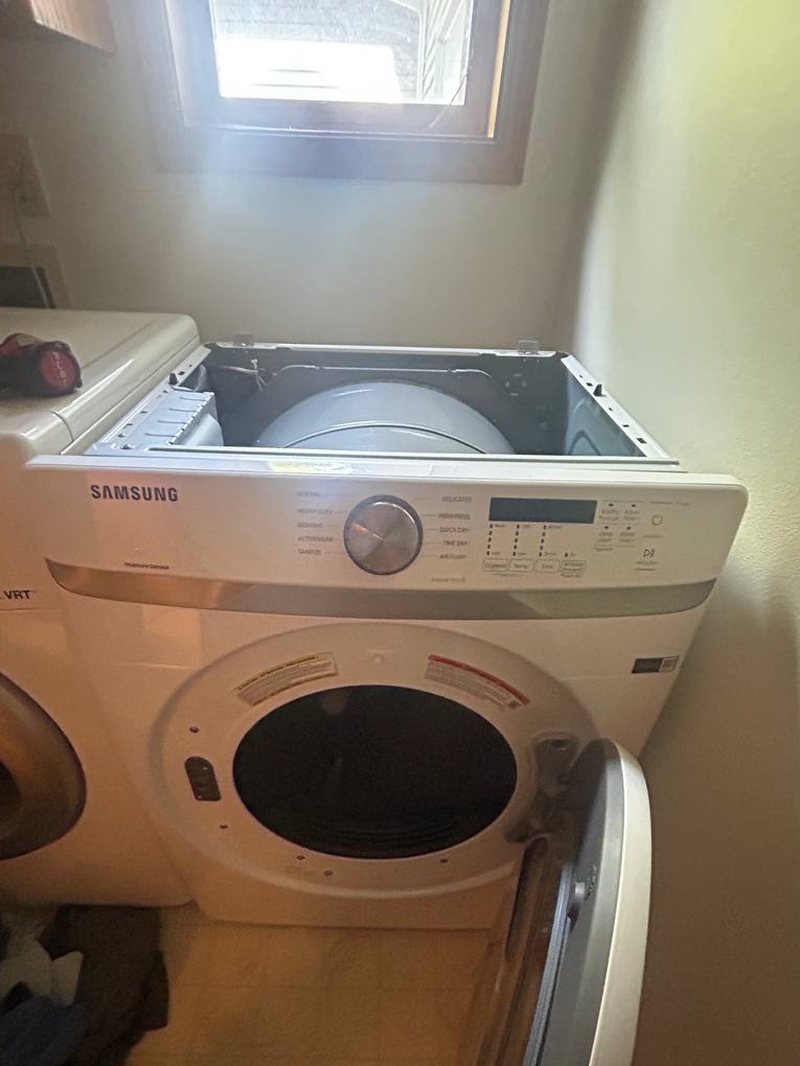
A Maytag dryer from the 1990s is a different machine from one built after Whirlpool took over the name. The older dryers, the Dependable Care and Performa lines, carry the drum on a rear bearing and a pair of front glides, and they will run for decades if those wear parts are replaced when they start to squeal. The newer Bravos, Centennial and Maxima dryers share their parts with Whirlpool, and their failures are the thermistor, the gas valve coils, the moisture sensor and the electronic control.
We work on both around Olympia, from the Puget Street basements to the stacked laundry closets in condos near Percival Landing, and we tell owners of the old ones honestly whether a part is still made before quoting anything.
A metallic screech from the back of an older Maytag, or a scrape from the front, means the drum bearing or glides have worn to metal. On Dependable Care dryers the rear bearing is a ball-and-socket that dries out; the front glides are plastic strips. We replace bearing, glides and belt in one visit, since the cabinet is open anyway, and the dryer goes quiet for another decade.
The electronic Maytags stop with F23 or F22 when the exhaust thermistor reads shorted or open, leaving the control blind to exhaust heat. The sensor lives on the blower housing and fails from heat cycling, though a harness pinched during a move produces the same code. We meter it, inspect the harness, fit a new sensor, then check the vent, because a restricted exhaust cooks that sensor faster.
The burner ignites, warms the drum briefly, and goes out, leaving loads damp. On the Whirlpool-platform Maytags the valve coils are losing their grip as they warm. On propane installations toward Black Lake and Griffin we also find burners never converted from natural gas, with a yellow, lifting flame and soot on the burner tube. We renew the coils as a set and correct the orifice when it is wrong.
The air off the dryer is hot and the load is still damp after ninety minutes. Nine times out of ten the exhaust is at fault: forty feet of vent under a deck, a hood flap glued shut with lint, a crushed transition duct. We check flow at the hood, clear what we can reach, inspect the blower wheel, and say honestly whether the run needs a full cleaning.
The dryer shuts off after ten minutes with wet clothes, or runs on long after they are dry. Fabric-softener film on the pair of sensor strips inside the drum makes them report dry too early, or a failed harness makes them report wet indefinitely. We scrub and test the strips, trace the wiring through the front panel, and fit a new sensor when the old one is gone.
PSE power came back after the November blow and the Maytag did not, or it shows PF and will not start, or the drum runs while the panel ignores you. On electric models we confirm the full 240 volts is arriving, since a missing leg turns the drum without heat. Then we test the control's relays and the user interface, and replace the board only when it has truly failed.
| Code | What it usually means | What we do |
|---|---|---|
| PF | Power failure: the dryer lost supply mid-cycle and is telling you the load may not be finished. | Clear the message and restart; if it recurs without an outage, check the outlet, cord and terminal block. |
| F23 / F22 | The exhaust thermistor reads shorted (F23) or open (F22), and the control loses track of exhaust temperature. | Meter the thermistor and harness, fit a new sensor, and check the vent for the restriction that overheated it. |
| F28 / F29 | In most cases the moisture sensor circuit is open or shorted, leaving auto-dry unable to judge the load. | Scrub and test the sensor strips, inspect the harness through the front panel, and replace the sensor when faulty. |
| F70 | The main control and the user interface have lost communication, often at a connector after a power event. | Reseat and inspect the connectors, then test both boards and replace only the one that has failed. |
A Maytag dryer diagnostic is $99, and it buys a technician and meter at the dryer, the failed part identified without hedging, and a repair figure written on your ticket before anything is ordered. Go ahead and the quoted figure already contains the $99; stop there and $99 is everything you owe. Inside our ring around West Olympia there is no line for travel. If Maytag's own coverage still reaches your machine we point that out before proceeding.
Dryers are booked inside the week. Thermistors, coils, belts and glide kits ride with us; a board or a rear bearing for an older model may need ordering, and the trip to fit it costs you nothing more. Your invoice carries the printed warranty term, and rental owners can okay the work by text and have the invoice emailed.
For most of the Dependable Care and Performa models, yes. Belts, rear bearings, glides, thermal fuses, elements and gas valve coils are all still made. Control timers are the one part that has become scarce on some models, and we check availability before quoting. A thirty-year-old Maytag with a sound drum and motor is usually worth keeping alive.
In most cases F23 means the exhaust thermistor is reading shorted, and its companion F22 means open. The thermistor is the sensor that tells the control how hot the air leaving the drum is. Without it the dryer cannot regulate heat and stops. It is a modest part, but a restricted vent is often why it failed, so we check airflow too.
The valve coils are the usual reason on the newer Maytags. They open the valve when the igniter glows and the flame sensor proves the burner is ready, and as they age they weaken with heat and let the valve close after a few minutes. Replacing both coils together fixes it. A weak igniter or dirty flame sensor is the less common cause.
Houses on Steamboat Island, at Summit Lake, along Delphi Road and around much of Black Lake run on propane, and a dryer there should have a conversion orifice fitted. Left on the natural-gas orifice it burns with a tall yellow flame, soots the burner, and dries poorly. Orifice and flame get checked on every propane dryer we open.
Usually the vent, especially in Olympia, where dryer ducts run long under decks and through crawlspaces and stay damp half the year. If the air at the outside hood is weak or the flap barely lifts, the duct is restricted. We check flow during the diagnostic and name the culprit rather than sell a part the dryer does not need.
All Maytag machines → · Maytag washer repair → · Dryer Repair in Olympia →
The price goes on paper before a screw comes out.
Ring or use the form; a phone photo of the display or the model sticker saves a step. We ring back with an arrival window and text again as the van pulls off Woodland Square Loop.
The technician tests the suspect part with instruments, tells you in plain words what gave out, and writes the repair down as a single price. Your $99 is already inside that number.
Fill valves, defrost heaters, igniters, drum rollers, drain pumps, relays — the things well water, salt air and PSE outages wear out on this shore of the inlet. If we have to order something, the second trip is ours to make, not yours to pay for.
You watch the machine finish a whole cycle, the kick panels and the floor go back the way they were, and the warranty term is typed onto the invoice.
Tell us over the phone. For $99 a technician tests the machine and writes the repair down as one price with that $99 folded in, and the invoice carries the warranty term in print.