KitchenAid dishwashers are heavy, quiet and well built, and the part most likely to end a cycle early is the electronic control tucked inside the door.
Weekdays 7:30–5:30 · Saturday 9–1 · closed Sunday · Woodland Square Loop, at the Olympia–Lacey line
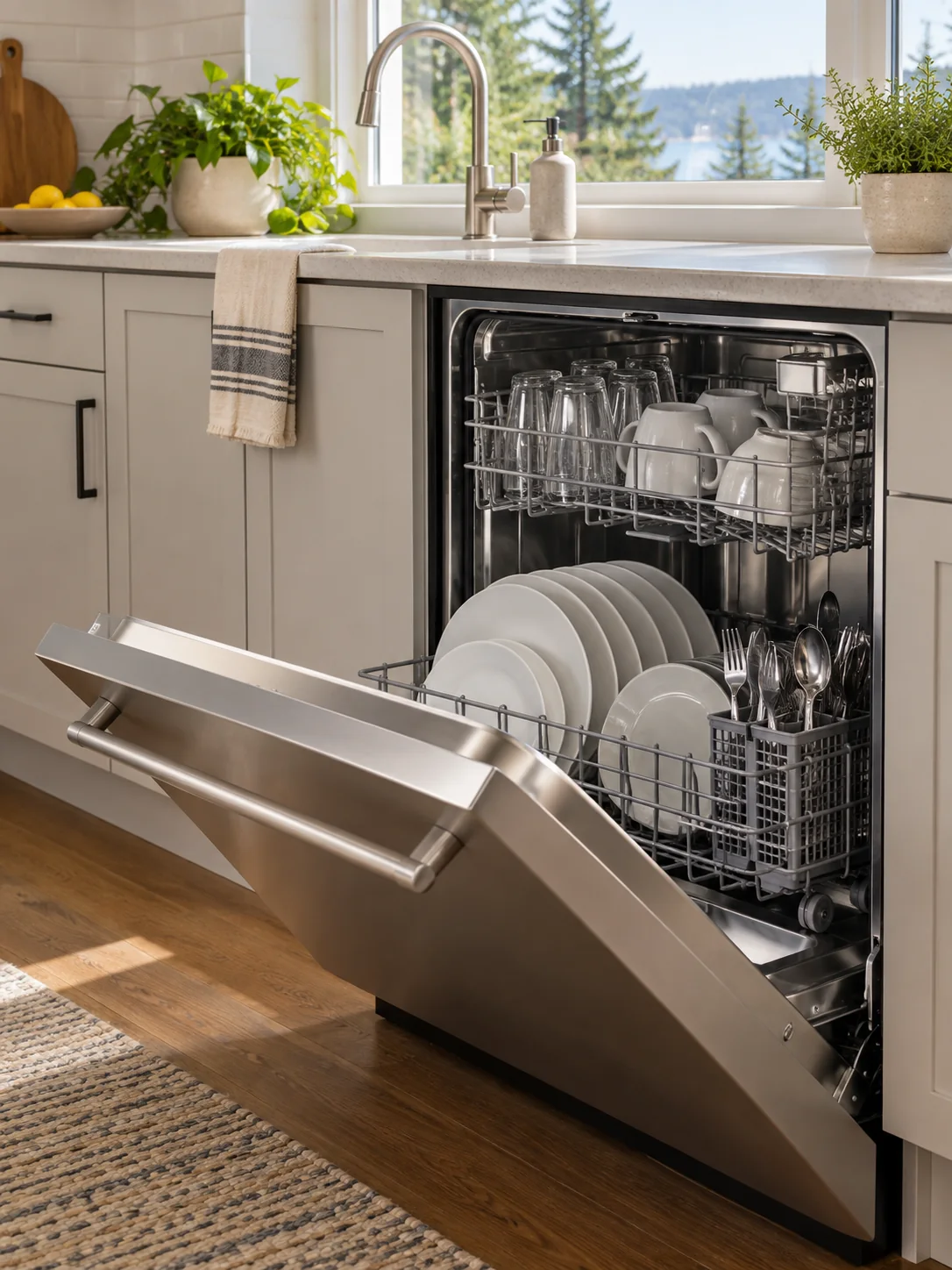
A KitchenAid dishwasher that stops mid-cycle usually tells you what happened with a blinking Clean light on the hidden-control models or an F-E code on the ones with a display. Seven blinks, or F7E1, is the heater; F8E1 is a slow drain; F2E2 is the user interface and the main control failing to agree. Count the blinks, and half the diagnosis is done before we arrive.
KitchenAid dishwashers turn up in Governor Stevens, in the newer houses off Kaiser Road and in condos near Percival Landing, and the calls cluster around the same parts: control board, heating element, the diverter motor feeding the upper rack, and, on machines past their twelfth year, the thermal fuse that guarded the old style of control. Well water toward Delphi coats the heater and spray arms in scale.
The Clean light flashes in groups and the cycle will not restart. On KitchenAid hidden-control models the pattern is a fault code: seven flashes for the heater circuit, eight for a slow drain, six for a fill problem. We count the flashes, confirm in service test mode, and then test the part the code names. The board is often only reporting the problem, not causing it.
The panel is dark, or the lights come on but nothing responds, or the machine starts a cycle and quits at the same point every time. KitchenAid's electronic control sits in the door and takes steam for years. We check supply from the junction box, the door switch and the thermal fuse before condemning the board, and when it has truly failed we fit the current revision.
Bottom rack spotless, top rack still wearing oatmeal. On KitchenAid the diverter motor under the sump switches water between lower and upper spray arms, and when it sticks the upper arm never gets pressure. A clogged upper arm or a cracked feed tube does the same. We step the diverter through its positions in test mode, clear the arm, and replace the motor if it refuses to move.
Water sits in the sump after the cycle, the tub smells, and F8E1 or eight blinks appear. KitchenAid's drain pump is a small separate motor that clogs with glass, seeds and jar labels, or cracks an impeller blade. We clear it, inspect hose and sink air gap, confirm the disposal knockout was punched out on a newer install, and fit a new pump when the old one is dead.
Seven blinks or F7E1 means the control tried to heat and saw no temperature rise. On KitchenAid the heating element loops around the sump floor and burns out, and on well water it wears a jacket of scale first. The thermistor or the heater relay on the board can fail the same way. We meter the element and thermistor, test the relay, and replace what has actually failed.
On KitchenAid dishwashers from the early and mid 2000s a small thermal fuse in the door protects the control, and when it opens the machine goes completely dead. Owners are told the board has failed; often it has not. We test the fuse, replace it along with the wiring harness that KitchenAid revised, and check the door seal that let the heat build in the first place.
| Code | What it usually means | What we do |
|---|---|---|
| F8E1 (8 blinks) | The dishwasher drained too slowly. In most cases a clogged drain pump, a blocked hose or air gap, or a disposal knockout never removed. | Clear the pump and drain path, check the knockout and air gap, and replace the pump if its motor has failed. |
| F7E1 (7 blinks) | The heater circuit did not raise water temperature as expected: element, thermistor or heater relay. | Meter the element and thermistor and check the heater relay before replacing anything. |
| F6E1 (6 blinks) | The tub did not fill, usually the inlet valve, a closed supply or a float stuck up. | Check supply and float, test the inlet coil, and fit a new valve when the old one is stuck. |
| F2E2 (2 blinks, 2 blinks) | The user interface and the main control are not communicating, often a connector or a failing board. | Check and reseat the interface connectors, then test each board and replace only the faulty one. |
A KitchenAid dishwasher call begins with our $99 diagnostic: technician and meter at the dishwasher, the failed component identified by name, and a repair figure committed to writing before anything is ordered. A yes means that $99 is treated as part of the repair figure you were given; a no means $99 covers our having looked. Driving to you inside our West Olympia ring costs nothing extra, and a dishwasher still under KitchenAid's coverage gets that mentioned before anything else happens.
Dishwashers are scheduled inside the week, weekdays and Saturday until 1. Elements, pumps and diverter motors ride with us; a control board sometimes has to be ordered, and its installation trip is arranged by us without a second charge. The printed warranty term is on every invoice. Property managers can green-light work over text; the invoice follows by email.
The number of flashes between pauses is a fault code. Seven flashes in most cases points at the heater circuit, eight at a slow drain, six at a fill or water level problem, and one or two at the control or its interface. Write down the count before you unplug it, because power cycling can clear the memory, and tell us the number when you call.
It is the problem often enough, but not as often as it gets blamed. A board that receives no power because a thermal fuse opened looks dead. A board reporting a heater fault is doing its job. We test the supply, the fuse and the part the code names before ordering a board, and we tell you what we found either way.
The diverter under the sump directs water to either the lower or upper spray arm, and when it sticks the upper arm gets nothing. A clogged upper arm or a split in the feed tube behind the rack does the same. We can run the diverter in test mode to see whether it moves, and the fix is usually the motor or a good cleaning of the arm.
Hardness shortens the heating element's life and plugs the spray arm holes with scale, and on Cooper Point, at Summit Lake and along Delphi Road most houses are on wells. A softener helps, as does a rinse aid meant for hard water and an occasional citric-acid cycle. We check the element for scale on every well-water call.
Often, yes. The stainless tub and racks on those machines outlast the electronics, and a fuse, element or drain pump is a modest repair. A board for a dishwasher that old is the one job where we pause and go over the whole picture with you before ordering.
All KitchenAid machines → · KitchenAid refrigerator repair → · Dishwasher Repair in Olympia →
The price goes on paper before a screw comes out.
Ring or use the form; a phone photo of the display or the model sticker saves a step. We ring back with an arrival window and text again as the van pulls off Woodland Square Loop.
The technician tests the suspect part with instruments, tells you in plain words what gave out, and writes the repair down as a single price. Your $99 is already inside that number.
Fill valves, defrost heaters, igniters, drum rollers, drain pumps, relays — the things well water, salt air and PSE outages wear out on this shore of the inlet. If we have to order something, the second trip is ours to make, not yours to pay for.
You watch the machine finish a whole cycle, the kick panels and the floor go back the way they were, and the warranty term is typed onto the invoice.
Tell us over the phone. For $99 a technician tests the machine and writes the repair down as one price with that $99 folded in, and the invoice carries the warranty term in print.